Push notifications vs SMS alerts: what developers actually pay for
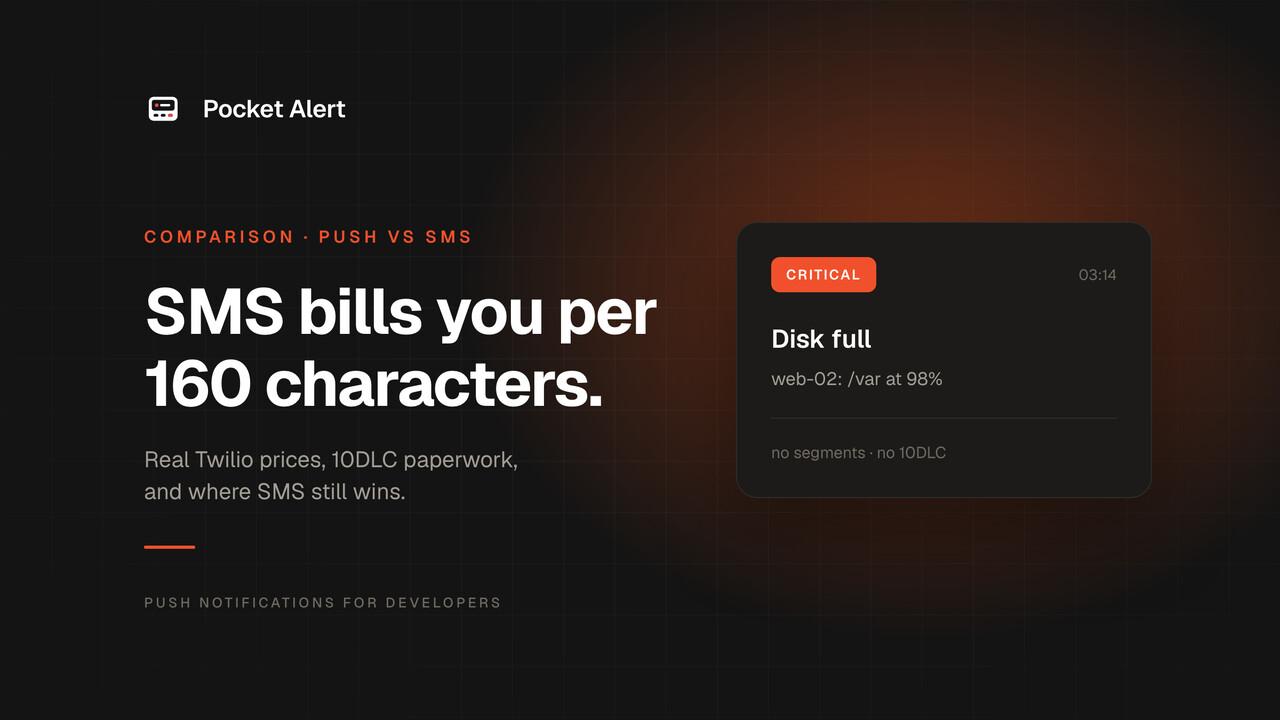
SMS feels like the serious choice for alerts. Every phone gets it, no app is needed, and it has been paging people for decades. For alerts you send to yourself or your team, though, push notifications are cheaper, faster to set up and say more per message. Here is the comparison with real numbers, and the one situation where SMS is still the right call.
All prices below are Twilio's US list prices as of October 2026. They change, so check Twilio's pricing page before you budget.
What an SMS alert costs
Twilio charges $0.0083 per outbound segment, plus a carrier fee per segment: $0.0035 on AT&T, $0.0045 on T-Mobile, $0.005 on Verizon. Call it about $0.013 per segment all in.
Then the fixed costs:
- A phone number: $1.15 a month for a local number, $2.15 for toll-free.
- A2P 10DLC registration (more on that below): a brand fee of $4.50 to $46 once, $15 to vet the campaign, and a monthly campaign fee of $2 for a sole proprietor or $10 for a standard business.
A worked example. A small setup sends 20 alerts a day, each around 200 characters once you include a hostname and an error line. That is two segments per alert:
- 20 alerts × 30 days × 2 segments = 1,200 segments
- 1,200 × $0.013 ≈ $15.60 in messages
- plus $1.15 for the number and $10 for the campaign
- about $27 a month, after a one-time $61 for brand and vetting on a standard registration
The same 20 alerts a day fit in Pocket Alert's free plan, which is 50 messages a day. If you outgrow it, the first paid plan is $6 a month for 1,000 a day, and the price does not change with message length.
Before the first SMS: registration
Since 2023, sending application-generated SMS to US numbers from a regular 10-digit number requires A2P 10DLC registration. Twilio's wording is broad: anyone sending SMS from an application to the US over a 10DLC number must register. Unregistered traffic is blocked with error 30034.
Registration means a brand (your business) and a campaign (what you send and why). Campaign vetting takes up to five business days for standard use cases. Without a tax ID you can register as a sole proprietor, limited to one campaign, one number and one message per second.
Toll-free numbers are no shortcut: since January 2024 they need their own verification, which takes about three to five business days, and unverified numbers are blocked.
None of this is hard, but it is paperwork with a wait before your first alert goes out. A push service has nothing comparable: create an account, copy a key, send.
160 characters, then you pay again
An SMS segment holds 160 characters in GSM-7 encoding. Longer messages split into 153-character segments, each billed separately.
The catch is the encoding. A single emoji or curly quote switches the whole message to UCS-2, where a segment holds 70 characters (67 when split). A 150-character alert with a ❌ in front becomes three segments instead of one, and costs three times as much.
Alerts are exactly the kind of text that grows: a hostname, a path, an exit code, a URL. A push notification has no segments, and the emoji is free.
What SMS cannot carry
- Priority. Every SMS arrives the same way. There is no field for "this one matters more", and getting through Do Not Disturb or Focus depends entirely on settings the recipient chooses on their phone.
- Buttons. You can paste a link in the text. You cannot add a button that opens the CI run, calls a restart endpoint, or copies an ID.
- A history you can search. Alerts sit in a messages thread on one phone, mixed with everything else from that number.
- Proof that anyone saw it. SMS delivery reports come from the carrier and, where available, the handset. There is no read status for plain SMS.
What push does differently
A push notification API flips most of that:
- Flat pricing. You pay per day or per plan, not per segment.
- Levels. Pocket Alert sends each message as
silent,low,default,highorcritical. On iPhone, high and critical come through Focus as time-sensitive notifications; on Android, critical overrides Do Not Disturb. See critical alerts. - Buttons. Up to three action buttons per notification: open a URL, fire an HTTP request, or copy a value.
- History. Every message is kept in the app and the dashboard, grouped by application.
- Webhooks. Monitoring tools, CI and payment providers can post straight to a webhook URL with no code in between.
Sending one is a single request:
curl -X POST https://api.pocketalert.app/v1/messages \
  -H "Token: $PA_KEY" \
  -H 'Content-Type: application/json' \
  -d '{"title": "❌ Disk full", "message": "web-02: /var at 98%", "level": "critical"}'
Where SMS still wins
Push needs an app on a smartphone and a data connection. SMS needs neither, which makes it the right choice when:
- The recipient will not install anything. Customers, contractors, or a landlord who should know the basement sensor tripped.
- The phone is not a smartphone, or has no mobile data plan.
- Coverage is thin. At a remote site with a weak signal, an SMS can get through where a data connection cannot.
- The message goes to the public, such as appointment reminders or one-time codes. That is what A2P messaging is built for.
For alerts from your own systems to your own team, none of these usually apply.
A sensible split
- Push for everything that comes from your infrastructure and goes to you or your team: failures, finished jobs, payments, signups.
- SMS for people outside the team who will not install an app, and as a fallback channel for the handful of alerts that justify the cost and the registration.
FAQ
Is SMS more reliable than push notifications?
Both are best-effort. Neither Apple, Google nor the carriers guarantee delivery time. SMS can get through where there is signal but no data; push needs a data connection, but arrives with a priority level and stays in a history you can check.
Do I need A2P 10DLC registration for alerts to my own phone?
If you send through Twilio from a 10-digit US number, Twilio's rule applies to anyone sending SMS from an application to the US, and unregistered messages are blocked. A sole proprietor registration is the lighter option if you have no tax ID.
How much does an SMS alert cost?
In the US, through Twilio, about $0.013 per 160-character segment including carrier fees, plus a $1.15 monthly number and a 10DLC campaign fee of $2 to $10 a month. An emoji cuts the segment to 70 characters.
Can an SMS bypass Do Not Disturb on iPhone?
Only if the recipient sets it up, for example by allowing that contact during a Focus or turning on Emergency Bypass for them. The sender cannot mark an SMS as urgent.
What is the cheapest way to get server alerts on my phone?
A push notification service with a free tier. Pocket Alert's free plan covers 50 alerts a day on iPhone or Android; see what a push notification API is for how it works.
If email is the channel you are moving away from, read push notifications vs email alerts next. Ready to try push? Create a free account and send the curl above.